“Ya basta!” – Celebrating an unfinished revolution

OAXACA, Mexico

Understanding social realities is an important part of learning Spanish and Mexican culture.  Unlike a packaged tour, immersion means you take what comes, the good, the bad, and reality  Today is the 104th anniversary of the Mexican Revolution.  Although it began as a Revolution, it soon descended into civil war lasting nearly ten years.  Its grim tally of untold deaths is often overlooked in favor of colorful characters like Pancho Villa and Emiliano Zapata.  Let’s start the day’s meditaton with the colorful leaders and look at the realities later.

That was then … or was it?

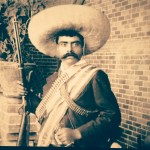
My friend Don Hilario, a former mariachi, took me to several places in the life of an iconic Revolucionario: Emiliano Zapata, the handsome general with a thick moustache, large sombrero, his chest crossed by bandeliers of bullets.  Don Hilario’s adult children and grandchildren – my friends – live in Minnesota.  He lives in Cuautla, Morelos, in a small house built against the stone and concrete wall of the ex-Hacienda Coahuixtla.

On my first visit in 2010, he put on his hat, picked up his cane, and led me into the ex-Hacienda.  It is a ruin, an empty shell of crumbling, stone buildings were landless peasants processed cane into sugar and died in dire poverty.  The Revolution smashed the hacienda system, including this one.  As we stood on a knoll, he pointed across the valley and said: “Over there is Zapata’s house.  Do you want to see it?”  Of course I did!

It’s the centerpiece at the Zapata Museum in the town of Anenecuilco (which he made me practice pronouncing).  The remnants of its adobe walls are protected from the weather by a huge nylon cover.  The immense mural presents the life of Emiliano Zapata in dramatic scenes and vivid color.  Zapta is the Revolution’s romantic icon.

When I visited him again in 2012, Don Hilario drove me to his home town, Quilamula, a pueblo in southwestern Morelos.  On the way, we stopped at ex-Hacienda Chinameca where a young teamster named Emiliano Zapata hauled the bricks to construct the hacienda.   In 1919, near the end of the civil war, Zapata’s rivals assassinated him there.   Quilamula is a poor town, and it was easy to imagine that many towns like it offered men as “guerreros” who followed Zapata for “Tierra y libertad,” land and liberty.

That night, in my guest room on the second level of Don Hilario’s small house, I stood on the balcony under a full moon.  Looking over the tops of the pomelo trees at moonlight and shadow, I was deeply aware I was as close as I could come to the Revolution of 1910.

This is now … or is it still 1910?

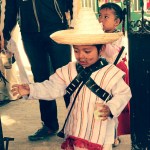
This morning I paused by the plaza of a kindergarten and peered through the wrought iron gate at the parents and children celebrating the Revolution.  Little boys wore small serapes, conical sombreros, and carried toy rifles; the girls wore long skirts with ribbons in their braids.  A fiesta for los “ninos.”

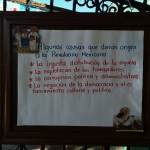
But an adult hung on the gate a framed, hand-lettered sign listing the causes of the Revolution:

  • Unequal distribution of wealth;
  • Exploitation of workers;
  • Political and adminstrative corruption;
  • Negation of democratic government.

Many Mexicans today wonder what has changed.  Is this 1910 over again?

Since the Spanish conquista, resources and wealth in Mexico have been largely in the hands of a small circle of influentials: Spaniards, then the criollos who succeeded them, and then the one-party government of the PRI (Partido Revolutionario Institutional) that ran Mexico from 1929 until 2000.

Expropriation of ancestral lands provided the spark for Zapata’s bottom-up revolt in the State of Morelos.  But Zapta’s was only one of several revolutions that erupted in different places in opposition to the 30-year presidency of  Porfirio Diaz.  Briefly united, the revolutionaries forced Diaz into exile.  After that, the country plunged into a decade of brutal conflict as generals and chiefs allied and betrayed each other in pursuit of conflicting agendas for the future of Mexico.

Unfortunately, ten years of civil war didn’t resolve these contradictions and establish a common vision that all Mexicans could embrace.  Nor did it create a democracy to off-set if not end the pre-Revolution system of oligarcy that had marginalized the campesinos and indigenous.  Only the names of the oligarchs changed.  The tendency toward oligarchy re-emerged within the state managed-economy run by the PRI.  Before its 71 year domination ended, the PRI co-opted and absorbed civic organizations, labor unions, trade associations, and cooperatives that might otherwise act as independent, countervailing forces.

Ayotzinapa – a flash back

The September 26, 2014, massacre of 43 student teachers at the hands of officials in Iguala, Guerrero, shocked a country already numbed by tens of thousands of deaths in a decade of the narco-violence.  Murders in Iguala resurrected memories of 1968 when he government used the Army to crush a student protest at the Autonomous University in Mexico City.  Like Kent State in 1970, the massacre at Tlatelolco left deep wounds.

The mayor of Iguala ordered the arrests of students because he feared they would disrupt an event held by his wife.  After the arrests, the police turned the students over to Guerreros Unidos, a drug gang, that killed them and burned their bodies.  Iguala exposed and confirmed the collaboration between drug cartels and local government.   Although the mayor of Iguala is in jail, and the Governor of Guerrero has resigned, the search for bodies goes on, and people wonder what other officials are controled by drug cartels.

Public anger is palpable, as is the disgust over corruption.  Daily press accounts reveal conflicts of interest and corruption among governors and other officials in cities and states throughout the country.  The President’s luxurious new home for his wife, however it is finally paid for, is more gas on the fire for citizens who don’t live in luxury.

Discontent and anger are evident in every place I’ve traveled -Mexico City, Puebla, Oaxaca, Tlaxiaco, and other pueblos.  Oaxaca’s Zocalo is a protesters’ camp of banners, tents and tarps.  Protesters march in Puebla and Mexico.  Banners hang in front of municipal halls and government buildings; graffiti and posters avow solidarity with the 43.  Youths slow traffic at toll booths outside Oaxaca to give travelers information and seek donations for families of the 43 dead students.

“Ya basta!” Enough already, is the prevailing mood.  Protesters are calling on the President to step down.

As I write this, officials in Mexico City have canceled the traditional celebrations in the Zocalo because of massive protests that are occuring.  Police and marchers are clashing near the International Airport.  In Puebla, students are marching in solidarity with the 43 murdered students.  Protests are occuring elsewhere.

After you make friends in Mexico, it becomes increasingly difficult to shrug your shoulders and feel nothing for the social and political forces affecting them.  Friendships can make these events personal.  What affects my friends, affects me, even if I can’t do anything about it.  For my many friends in Mexico, I hope for the best – whatever that may be.   

After a decade of narco-violence and political corruption, will the Mexican people rise up in revolt?  No one can say for certain.  The Revolution remains unfinished, its promises unfulfilled.  The grievances of 1910 are with us yet.  Are there grievances enough to spark a national uprising?  No one knows for certain, but there is something in the wind.  And if there is an uprising, will it have a unifying vision for Mexico?  No one knows.

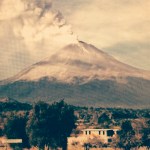
Like the volcano Popocatepetl, the body politic has errupted periodically since 1910, the outrage arising over one greivance or another, and then subsiding.  But like El Popo, the causes of unrest remain and the social magma is moving once more beneath the surface.  The phrase: “Ya basta!” has real force.  Mexico, like El Popo, is never dormant and the risk of eruption remains.  “Ya basta!”



Speak up – I can’t hear myself

OAXACA, Mexico

Thinking aloud is another simple but highly useful exercise.  Ours minds are constantly working on something, or holding imaginary conversations with someone.  We all do it.  So why not harness all that mental energy to push forward your Spanish fluency?  It’s free, ecologically friendly, one size fits all, and it’s highly effective!

Oh, but you may be suspicious of people who talk to themselves.  And you don’t want to be the object of suspicion.  Afterall, they must be losing their marbles.  Think again.   Aren’t we always muttering under our breath: “Let’s see, where did I put my keys?”  Or, “One of these days, I’m going to ….,” or “What does he take me for, an idiot?”  But you still say you don’t talk to yourself.  Well, they say there are only two groups of people who don’t talk to themselves: Those who are crazy, and those who are dead.   Which are you?

Whether we are aware of it or not, our minds generally operate in imaginary dialogues – posing questions and framing answers, making calls and giving responses.  The fact is, I talk to myself and so do you!  I give myself an affirmation (“That’s good,”) or I vent my frustration (“How stupid!”), or unload some annoyance (“What a piece of shit!”).

One evening while here in Oaxaca, counting out my pills, and putting them into the spaces of a plastic pill box, I caught myself counting out loud, under my breath – in Spanish.  So, enough of denials!  We all talk to ourselves.  Let’s put it to good use!

Lips moving, no sound

Before I retired, I had an easy morning commute with no traffic to speak of.  For years, I’ve talked to myself during morning commutes.  Completely alone for 35 or 40 minutes, I worked through or rehearsed the ideas for the day’s meetings.  It’s a habit.  After completing two immersions, and possessing enough working language, I held my private conversations in Spanish.  Because the topics were familiar onesI could concentrate on Spanish.  Practicing in the car (like singing in the shower) gave me a double benefit: Working through a practical problem while using my Spanish in a practical way.  

I didn’t worry about other commuters who might see me talking – lips moving.  Let them think I have a Bluetooth and I’m talking on my hands-free cell phone.  Who cares?

But, before you put your hands on the wheel and start the Spanish monologue, let me add a couple of cautions.

First: Don’t try this in heavy city traffic.  You may be concentrating too much to see the traffic signals.  Deep in monologue, I didn’t see a red light one morning and made a left turn against traffic.  Fortunately, no accident, but thereafter I confined my dialogues to the open highway.

Second:  Keep the topics fairly light.  That way you won’t be so absorbed in conversation while on the highway that you miss an exit, which I’ve done a couple of times.  (But I’ve also missed the same exits thinking quietly in English.)

Still, I think this is safer than driving while texting or talking on your cell phone.

Try this:

Spend a couple days being conscious of when and how you talk to yourself.  What kinds of conversations do you have?  And when?  Make a note of them and look for patterns in your particular way of talking to yourself.  How you talk to yourself is particular to you.  Knowing this may help overcome any reluctance to try it deliberately.  You will see this as a part of who you are.

A deliberate conversation with yourself will feel unnatural at first.  Like a kite without wind, you might not get it off the ground at first.  In that case, give yourself some “wind.”   Outline a situation that’s familiar to you, something about work, or vacation, or your children.  Remember, it’s an OUTLINE, and not a speech, a bulletpoint list.  Now, go to someplace where you can be alone – the basement, the garage or your office – close the door, and practice.  Don’t worry about correct grammar or syntax.  No one but you will hear anything.  And once you feel comfortable with your voice, and accept it, speaking Spanish may become easier.  Before you know it, you’ll be putting out the words with less effort.  Sooner or later, you’ll stop hemming and hawing as you paw through your memory for the right words. 

While we’re talking to ourselves, locked in the bathroom with the shower running, this is a good time to check in on our Spanish accent.  How do you sound?  Do you have an accent?  And how does it sound?

Try this: 

If you have access to a cassette recorder or a smart phone, you’re in business.  Find something easy to read in Spanish, even a children’s book will do.  The text doesn’t matter.  Or if you’re really confident, record your impromptu monologue.  Turn on the recorder and read or speak aloud your text and record it.

When you’re done recording, play it back and listen carefully.

Maybe you hear yourself pausing, um-ing and ur-ing between the words as you read.  From this you might conclude you need to work on self-confidence, or diction, or both.  One tends to influence and reinforce the other.

Or maybe your words aren’t wholly clear, or maybe the vowels are a little “flat.”  That is, the long “A” sound in Spanish (the English letter “E”) might sound too much like “uh.”  Or the long “E” sound (the English letter “I”) might sound too much like “ih.”  This suggests a simple exercise of consciously or deliberating practising the vowel sounds until they’re second nature.  I do the same to my adult English students in Tlacochahuaya.

Save this recording and then record yourself again a couple of weeks later.  Compare the two recordings.  You should hear the difference if you’ve noticed areas for focus or improvement.

You can also compare your accent and diction with Spanish speakers – either those you already know, or listen to tapes, movies, or TV programs for comparison.

Recording your voice and comparing to the sounds of fluent speakers can turn up the strong and weak spots in your spoken language.   This, in turn, will point the way to exercises and practices most likely to pay off.

In short:

Talking to yourself will strengthen and expand your capacity for thinking in Spanish.  In time, this will expand your confidence as well as your range of vocabulary and expression.  And don’t worry about what others might think.  Chances are they’re looking at their phones!

Rainy day Spanish – when you’re all alone

OAXACA, Mexico.

As a farm boy, a rainy day meant staying indoors, freed from chores, with “nothing” to do but read books.  I fell in love with reading and rainy days.  If  you live in a desert, you can declare for yourself a ‘rainy day” and take up reading – in Spanish!  Here’s how it works:

Julita, a Mexican friend, arrived in Minnesota twenty-five years ago with two small children.  She didn’t speak English and neither did they.  Being an intelligent and determined woman, she supported her family by cleaning, and set about learning English on her own.   Her children are now adults and native speakers in both languages, and she talks as readily in one tongue as the other.  How did she do it?

She read to her children.  Not the simplest children’s books, but books with characters and plots.  Her favorite was the “Amerlia Bedelia” series.  These books revolve around literalness, figures of speech, and the humorous mishaps of Amelia.  But she told me – with a smile –  she read mostly for herself.

Like Julita, I stumbled upon the same strategy early in my Spanish studies.  Without forethought, I bought a memoir about growing up as an undocumented immigrant in the late 1940s.  The author is my contemporary in age and a university professor in California.  He wrote a simple narrative at a 9th grade level.  I caught the drift of the story, but not the color and details.  Those I looked up.  Unfamiliar words on the page revealed themselves when I sounded them out (as we did as grade-school children).  Soon, I read aloud, just under my breath, and the story took on greater depth and meaning.  Somehow, hearing the word as I read it increased my comprehension.

Although I’m fluent now, and sight-read Spanish, I continue to read aloud, particularly when I’m not in Mexico.  Reading aloud is a good strategy and I believe sharpens several language skills at the same time.

Imprinting the language:

1) I learn the words as I speak them.  This seems to imprint the words in my memory for pronunciation and meaning.  (There is research that combining learning with a physical act strengthens retention.)

2) Besides receiving the word visually, I hear it as well in my own voice.  Letters and sounds go together as a single action.  This makes it easier to recognize the word when I hear someone say it.

Physical training:

3) By reading aloud I practice the physical act of making the sounds.  Some sounds are not as easy to make as others, such as the rolled R – as in “perro,” or the sound of double L as in “llamar.”   Unlike English, Spanish articulates every vowel separately, and this isn’t always easy to do.  Reading aloud helps to train the muscles of my tongue to make the sounds it’s not accustomed to making.  Think of reading aloud as a “work-out” for your tongue muscles.

Linkages:

4) Reading aloud creates linkages between sight and sound with words commonly used phrases, such as “asi como” “antes de que,” and others that stitch together nouns and verbs.  When reading, we tend to see one word of phrase at a time.  But speaking is an almost unbroken flow of sounds.  Native speakers often fuse the sounds of words to the point non-native speakers can’t distinguish them.  (We do this in English, too:  “seeya later,” “doncha know”, etc.)  If we’re not attuned to the sounds as they link and fuse, we may quickly lose the thread of the conversation.  Reading aloud can help create and reinforce these links.

Rhythm:

5) There is rhythm to the spoken word.  We all have a distinctive, individual rhythm speech that identifies us as surely as a photo.  We instantly recognize friend or family by their voice over the phone.  Reading aloud – but particularly if the book has dialogues – may help develop your particular rhythm, one that is natural to you.  Speaking naturally will improve your confidence as well as your fluency.

Try this:

If you already know even a little Spanish, buy a Spanish language book (children’s or young adult) that fits your level of fluency.  Then read aloud to yourself and listen to your voice.  You may not understand all the words the first time through.  In fact, I can almost guarantee you won’t, unless you bought a book below your level of experience.  But read slightly above your level, underline words you don’t understand, and continue reading.  You will likely re-read a paragraph or sentence; and when you do, check to see if the context tells you something about the underlined words.  If you have to look them up, do it later rather than break your rhythm and concentration.

I still do this as an exercise.  A friend recently gave me a book of Mexican short stories; the writing is literary, the plots are subtle, and some of the words escape me.   I often reread paragraphs, even whole pages, before I get it.  But it strengthens my vocabulary.  I carry this or other books with me and read while waiting to meet a friend.  I also have some bi-lingual anthologies of short stories, but I’m not convinced they’re as helpful.  To me, at least.   But that’s a personal preference.

Yesterday, I spent several hours in the Centro Cultural de Santo Domingo, Oaxaca, in the galleries of artifacts from the early period of Zapotec culture.  Besides the cards identifying the fetishes and funeral objects, there were panels explaining the background and details of the culture.  I read them aloud, just under my breath, my whispers floating down the empty hallways.  I read aloud as fast as my eyes could sweep over the words, and the comprehension was complete.  When I stopped reading aloud (because someone was close to me), my rate of comprehension slowed noticeably.  Why?  For all the reasons I’ve outlined above, I suppose.

To repeat something I’ve said before: language is more than words.  It is also a physical activity that engages our brain, our emotions, and the muscles of our mouths.  All must work together if we are communicate and understand the words of others, whether written or spoken.  I believe effective language learning requires careful attention to and training of these distinct parts of our being: mind, body, and soul.

To sum up:  Reading aloud is an easy but effective way to boost your language capacity.  It’s cheap.  You can do it anywhere, at any time, when you’re alone.  And who knows, you may look forward to rainy days.

Tianguis – being comfortable among strangers

One day during my second immersion, a Mexican couple surprised me by asking for directions to a street in Puebla.  I knew the street and gave directions.  ‘Can’t they tell I’m a foreigner?’ I wondered afterwards.  Why did they ask me?  And it’s happened many times more.  I suppose the couple saw me dressed like other men in Puebla, walking confidently, the way a resident walks to a destination. They saw me as part of the social context.

Social context is our environment of the moment. Becoming comfortable in it is one key to “feeling” the language. If we’re comfortable in our social context, then we’re less likely to feel self-conscious, and more likely to act confidently.  And speak confidently.

Becoming confident in a new social context may take some practice, but the skills can be mastered quickly, if you haven’t mastered them already.  This exercise is about finding confidence and expanding the social  “comfort zone.”

Try this:  Spend a day or two watching people:  Notice how they greet each other, their gestures, inclinations of the head, tone of voice.  Notice how they dress (or look at photos of your desstination).  Make a habit of observation, and then dress and act to ‘blend in’ as best your can.  This may feel like acting, and to some degree it is.  But you are the actor and primary audience.  After the performance, you will  feel more comfortable and speak more confidently.

Along the way, try to pick up clues to the “mentality” of the culture.   English and Spanish languages operate according to different mentalities.  You may notice that Mexican Spanish is very physical; people talk with hands, gestures, and expressions more than many Americans do.  As I learned in my second immersion, Mexican conversations seem more ‘circular’ in nature than ‘linear.’  That is, in Mexico there is a fuller expression of each speaker’s personal or inner reality and opinion; whereas in American English the conversation as a more exterior reality with a focus on the ‘facts’ and analysis of the subject.

To a degree, these differences are somewhat ‘hard-wired’ from experience.  I co-chair the parish council of a Hispanic congregation. There are time during our meetings when the conversation goes round and round, and I’m impatient to reach a conclusion.  That’s when I realize I’ve drifted outside the cultural context and I’m subconsciously thinking like an American, and not a Mexican.  Then I need to sit back, relax, and rejoin the culture.  Everyone is exploring the subject from their personal point of view, perhaps through a series of overlapping expressions that reaches a consensus.

Try this: Listen closely to English conversations to notice whether the focus is on the speaker’s inner realities or is the forcus principally on facts, data, and analysis.  If its the latter, can you think of a way to convey the same information more subjectively, in story form?  And would anyone believe you if you did?

I started the third immersion, knowing that to speak Spanish like a Mexican I had to think like a Mexican.  American and Mexican cultures differ in many respects, and these can subtly influence syntax and grammar.  Understanding if not acquiring something of the mentality can help you speak – if not like a native – with greater precision.  Relationships between things are expressed differently and sometimes indirectly.  It’s common to say (in Spanish)  “Me da mucho gusto recibir tu carta,” that is, It gave me much pleasure to receive your letter.  Recieving gave me the pleasure.  Whereas in English, I might say, “I was happy to get your letter.”  Notice the verb focuses on me,  The differences are subtle, but real.  If we came upon someone crying, we would probably say: “What happened?” in English.  But in Spanish, we might say: “Did something happen to you?”  The English version comes off more as interogation; the Spanish is more an indirect question.  Subtle but important.

Think of becoming comfortable in the context as an integral part of the language – which it is.  But – and there is always a but – but you can’t escape being obvious in every social situation. And in those situations, making yourself comfortable despite standing out, can work to advantage.

This weekend I took a bus to Tlaxiaco, a city of 60,000 in the mountains northwest of Oaxaca. This is a Mixteco region where many speak Spanish as their second language.  I went there to see the large Saturday market or “tianguis” that draws hundreds of vendors and buyers from the surrounding towns.  Tlaxiaco is a regional crossroads and economic hub.  Like mushrooms, temporary tiendas rose overnight, filling the streets and plaza around the town’s clock tower; merchants did brisk business all day with local residentss (few to no tourists), and vanished with the night.  I spent the day among the stalls and tents, visiting with vendors and artisans.

On Saturday, I seemed to be the only “guero” or white person in town; I knew I stood out, and there was no way to ‘blend in’ as do in Puebla.  Very quickly, I discovered that ‘standing out’ can work to advantage.  People are inherently curious and wanted to know where I lived, did I have family, did I like it in Tlaxiaco, etc.  In short, their curiosity is an open invitation to conversation.  It was a gift to you.  If offered to you:  Take it!

During the course of seven hours, I visited with dozen vendors for more than fifteen minutes at a time.  From vendors and artisans I learned things not found in guidebooks.  People told me bits about their personal history, a cousin who works in North Carolina, their own brief sojourn in the U.S.,  their family, their work.  Their openness make me comfortable because they were as interested in me as I was in them.  Each encounter made me more at home in Tlaxiaco.

Men do the heavy lifting of erecting the tiendas, but it’s the women who run the tianguis.  When I came upon two women smashing white rocks into small pieces, and bagging them for sale, I had to ask a question.  The older woman in a straw hat told me they were breaking up marl for cooking with the corn for tamales. “This is a special rock,” she said.  The rock is largely calcium and it dissolves when boiled with the corn used in making the masa or dough for tortillas. I left them knowing more than I had before.

Later, I sopped at a large stand of chilis in burlap bags, and took a deep breath to savor the scent. The woman asked what I wished to buy.   Nothing, I said, and added that I stopped to admire her wares and inhale the scent of chilis.  This led to questions and answers about the kinds of chilis and the dishes in which they’re the key ingredient.  As I turned to leave, she gave me a handful of chilis as a gift.

More conversations followed with a woman who sold barks, leaves, and seeds as homeopathic cures for practially anything.  Each box of product labeled with a list of physical conditions the bark or leaf relieved, from headaches to anxiety to diabites.   Several vendors invited me to taste the fruits and other foods, many knew to me.   And always, informal conversation, questions asked and answered, a reality explored.

I ended by day talking with two Mixteco women, mother and daughter, sitting on a mat cleaning ‘aho’ or garlic and twinning the stems together, six garlic to a bunch.   Their question whether I wished to buy led to conversation and questions.  Before long, I was sitting on the plaza with them, and we were talking about our respective lives, families, and experiences.  The older woman, who gave her age as 80, had a soft voice and warm smile.  She lived nearby, her family raised garlic and other fruits.   Her daughter worked with her.  She told me, with some sadness, that her grandchildren didn’t want to learn or speak Mixteco, which is her first language.   They wanted only Spanish.  Without her saying so, it begged the question: “Who will carry on the culture?”  Who will take a tongue and culture of several thousand years into the twenty-first century?

That’s Tlaxiaco.  The sights, the sounds, and the smells of the ‘tiagnuis’ are lovely and fascinating on the surface.  But richer still is the connection of the tianguis to the place itself, and to the people of Tlaxiaco.  It’s in the organic connections of people to the place, and the place to the tianguis that the culture and languages – Mixteco and Spanish – live and evolve.   The Spanish of Tlaxiaco isn’t textbook Spanish, its a working language of slang and jargon and Mixteco words rooted in time and place and, hopefully, a future.


Shifting focus – “feeling” the language

OAXACA, Mexico

Can you “feel” the language when you speak Spanish? That is, do you have a sense of emotional confidence?  The kind of confidence to meet whatever circumstance you’re in?  Being self-aware of our emotional state is a useful aid in gaining fluency.  With confidence,  our focus shifts away from thinking about the words and grammar to focusing on the content of what we want to say.  This is something that seems to come with practice.

Everyone learns in their own way, but some fellow students have had common experiences on the road to fluency.   These are moments to treasure, like hitting a homer with the bases loaded.  Let me share several of my high points.

At the end of a food bank consultancy in Guadalajara, Luz, the chief volunteer and President’s wife, took me to a food distribution. After introducing me to the local leaders with generous praise, she turned and looked directly at me.

Suddenly, I realized she expected a response.  I had to say something more than “Gracias.” And I wasn’t prepared! Or so I thought. Swallowing momentary panic, I began, by thanking Luz for her kind words. And then I forgot about the words and concentrated on what I felt, what I wanted them to know. Miraculously, the words poured out without conscious effort, without hemming or hawing. I couldn’t quite believe what I’d just done: A spontaneous speech.  I felt both joy and pride.

Immersion experiences, formal and informal, can give us the base of experience to “feel” the language. By feeling, I mean an unspoken, intuitive trust that the necessary words will come to us when we need them. Think of Nik Wallenda, who walked the cable between Chicago sky-scrapers.  He succeeded because he wasn’t  preoccupied with falling.  Like him, we’re more likely to speak well if we aren’t preoccupied with making mistakes.

Test this:  Deliberately let yourself be drawn into a Spanish conversation that enters territory not covered by lessons, or involves somewhat complex topics. Asking someone about their profession is a good way to do this. Chances are you’ll enter a vocabulary thicket without a map. It’s a good way to practice trusting your intuition to serve up the words you need at the right time.  The words might be English cognates for Spanish ones, but you can modify many with ease.  And if you don’t know, you can always ask: “Como se dice,” or how does one say ….? One way or another, you can find a “work around” as you describe the idea, situation, or action for which you don’t have the exact word.  Even a work-around is a good exercise in conversation.

In the beginning, speaking Spanish in a complex conversation made me nervous.  It was like the first date with a girl I really liked.  I felt insecure, socially awkward, and wished I hadn’t asked the girl out.   The first date is always the hardest, but if you can survive the first date, and overcome the fear of rejection, or humiliation at your own hands, who knows? You may soon “go steady.”

Here are some signs to look for as you progress in building confidence on the road to fluency.

Dreaming.

Our minds rarely rest.  I remember waking from a dream in the middle of the night during my first immersion.  In stunned disbelief, I realized I had been dreaming in Spanish!  It happens to a lot of students. If it happens to you, trust it. It doesn’t mean you’re fluent, but it’s a sign you mind is absorbing the langauge at a an unconscious level.

Oblivious to the language you speak.

During my third week of immersion, I patiently answered a Mexican student’s interview questions for her English class project.  After the third question, the student’s companion stopped me and said: “Ingles, habla en ingles!  Tu hablas en espanol.”  That is, speak English, I was answering in Spanish and didn’t know it.  Again, I was flabbergasted that Spanish was becoming an unconscious “default” language.  What was happening to me?  Now I know.   And it’s happened several times since, in both languages. It’s another sign.

Catching mistakes before and after you make them.

Another sign of progress is catching yourself making or about to make a mistake. Relax. We all do it. Our brain moves faster than our tongue, our mind edits as we speak, and sometimes we change our mind, leaving our tongue still trying to conjugate verbs we’ve rejected on second thought.  We all do it in English, too.  Don’t criticize yourself for small mistakes. Perfectionism is a crippling disease. As a good yardstick, listen to how you speak English and note how often you make mistakes, or edits, or “uhs” and “ers.” Our conversations aren’t oral exams with a final grade. As long others understand us, we pass. Not trying at all is the only failure.

More energy at day’s end.

As Spanish sinks deeper into the subconscious, you may feel more energetic than when you started Spanish.  When we stop thinking about the language, and start feeling it, it takes less and less energy.  Being at ease means focusing on what you want to say, not how you want to say it. It’s like shooting a moving target; you follow the clay pigeon with your eyes and your body automatically brings the gun into position.

Talking with your hands.

You may also notice that your body language changes as you gain proficiency. The changes may be subtle or obvious. You may find yourself talking with your hands as well as your voice where you never did that before; or use more emphatic gestures. I notice that in Mexico I use my hands more than I do when talking in the U.S.

Try this:

Pay attention to your emotional state when engaged in a conversation that is going well, perhaps going easily. Notice how you feel, how much conscious energy are you investing in it.  Is it flowing without apparent effort?

How you feel when you speak – confident, nervous, fearful – will influence how well you speak. Self-awareness is one key in gaining fluency.  Like the tightrope walker, success lies not in looking down but in looking ahead.

Be sure to let me know if this works for you!

Dia de los Muertos – to be, or to be, on the Day of the Dead

OAXACA, Mexico

Just before the Day of the Dead, while sitting in an outdoor cafe, two men with guitar and pan pipes play “Dust in the Wind,” a haunting song of the mid-70s. It’s chorus line is: “all we are is dust in the wind.” I love that song, but in Oaxaca, on el Dia de los Muertos, the living and the dead are not dust in the wind;they are mmuch more than that.

El Dia de los Muertos is a uniquely Mexican celebration of indigenous origins that, to an American eye, appears as a colorful, magical celebration mixing elements of Halloween and Mardi Gras. But it’s neither of those. It began as an indigenous celebration of Mictecacihuatl, the guardian-goddess of the dead. Spanish missionaries co-opted this festival and merged it with the celebration of All Saints and All Souls days (November 1 and 2) creating the syncretistic Dia de los Muertos.

Yesterday Estella’s extended family gathered at her mother’s house for “la comida” or dinner. There, a large “ofrenda” or altar flanked by huge bouquets of marigolds and tall candles filled a nook in the room. The ofrenda is the focus of the celebration. A dark wooden crucifix, a family heirloom of some 200 years, sat in the center. On either side, photos of the “difuntos,” or deceased of the family. Before them were tamarindos, bananas, pecans, bottles of cerveza and mezcal, aand other things the difuntos liked. This is an offering to invite their spirits to join the rest of the family for a visit.

We sipped mezcal and beer, feasted on mole negro, a traditional and piquant dish Estella cooked in a large, clay casarola over a charcoal fire in the courtyard. The mole and rice and tortillas, the beer and conversation made for a festive day. Later, back in our neighborhood, a brass band played in a cobblestone alley, children and adults in faces painted to resemble skulls, danced to the music. Bands played in every barrio of Oaxaca, people danced until morning’s first light, tired but happy.

Festive but not trivial, serious but not morbid, the skeleton figures, the flowers, the pan de muerto, and other decorations are festive, colorful, and symbolic; each one carries a meaning beyond words. Each icon speaks to the nature of “being,” of mortality. It’s a celebration of life and “being” and transcendance; it’s a celebration that we are more than dust in the wind.

Day of the Dead begs the question of: “What is being?” Being. Being alive. What are your ideas about your “being?” Or the meaning of “to be?”

Spanish has two forms of “to be,” two forms of “being” One form of to be (ser) refers to what is permanent, inherent; the other form of to be (estar) expresses impermanence and change if not action. Maybe we haven’t considered these questions before. But if we do, we can consider them clinically, standing outside the culture, or, like language immersion, we can enter into the moment and understand the question through participation. In either case, the meaning of the Dia de los Muertos confronts us with the question of “being” and, by extension, the verbs for “to be.”

For me, el Dia de los Muertos speaks to the miracle of being human and mortal as well as human and spiritual. The skeleton figures and masks remind me that, beneath our present status, position, and wealth, we are all skeletons; we are all equal in death. This is a reminder we are transitory beings in this world; We are and then we are, but not as we were before. Or so we believe and hope.

And then there is the practical conundrum of using the two Spanish forms of the verb “to be.” “Estar” refers to a transitional or temporary state of being or location as in: “He is ill,” or “She is late,” or “They are here.” “Ser” refers to inherent and unchanging aspects of one’s existence as in: “My eyes are brown,” or “I am a man.”

Which one to use? English has only one form of the phrase “to be” and it encompasses both temporary and inherent states of being. The conjugation of the English verb form doesn’t change to distinguish permanent from temporary being. We distinguish by modifying the phrase with an adverb, as in: “He was ill temporarily.”

But it’s one thing to learn the rules of grammar and quite another to use them correctly in a conversation, especially when we’re accustomed to using one form. Which state of being applies? How can I tell? Well, I said to myself, if the being can move, it’s probably changeable so my choice is “estar.” And if it doesn’t move or change, then it’s probably “ser.”

But it isn’t always clear cut and there could be a cultural twist as well. I faced this when writing an essay of impressions about my first encounter with el Dia de los Muertos. In passing, I mentioned my mother’s death and wrote: “Mi madres es muerto,” stating she was in a permanent state of non-being. Death to an American seems permanent and inherent.

My teacher read my essay, arched her brows, and then said: “No, tu madre esta muerto.” Why, I wanted to know. She’s not dead temporarily, and she’s not going to return to life. Isn’t death inherent andn permanent? No, that’ wasn’t the case. When she was living, it was “esta vivo,” and that changed with her death to “esta muerto.” Alive and dead, being and non-being are changeable states of being.

“To be, or not to be” came to mind. Until that moment, it never occured to me I could have different states of being at the same time. I am a man with brown eyes, and I am tall (inherent qualities), but at the same time I am happy, chilly, and dressed (changeable states). Our being is fluid, in a metaphysical sense. And I never would have thought of it but for Spanish.

If you are still with me – Bravo! You may be wondering what is the point. It’s this: the structure of language has a metaphysical aspect that both reflects and affects how we live our daily lives. If we poke at this enough, we may see in the verb phrase “to be” nuances about the meaning of life and death we hadn’t encountered before.

Yes, a person’s physical state does change with death and the spirit leaves them. The mystery of life is that we come out from a state of non-being, we live, we die, and enter a different state of being. We are never alive forever as mortals. Yet, when we speak of the deceased of the dead as “esta muerto,” we go on to describe their physical features using the “ser” form of to be because they were inherit to the deceased. Thinking this way can be a little mind-bending. Distinctions such as these do influence the culture and shape its approach to death and life. It has influenced my view.

In my room I receted a small “ofrenda” on a credenza with a photo of my parents in the enter, with papel picado (pierced paper), a vase of cempazuchitl (marigolds), and flor de muerto, a painted crania, and a candle. In the photo, my parents are forever in their late 40s, still full of “being,” and about to set off for an evening event. For awhile, I sat vigil in my room, remembering them, and through remembrance, something of them returns to me.

Are memories transitory or permanent? Should I use “ser” or “estar” when writing of them? I don’t know. But I do know this: Our “difuntos” live on in memory, and for as long as we, and our children, and maybe their childre remember us, we live and they live and we are not “dust in the wind.”

Chance encounters, improv Spanish

OAXACA,Mexico

Two college-age women approached me today near Oaxaca’s Santo Domingo.

“May we sing a song to you?” they asked. One was short, with braces, and dark hair; the other was taller, fairer, with curls.

“Why?” I asked, surprised at the request.

“We just want to make you happy,” the one with braces said.

“Make me happy for a donation?” I replied.

“Only if you want to,” the other said.

“Okay,” I said. “Please sing ‘Las Mananitas,” a traditional birthday and celebration song. They cleared their throats and sang reasonably well. After that, we talked for a moment and I learned they were art students. One studied drawing, the other painting. I gave them a few pesos, and the one with dark hair asked if I would like to hear “Cancion de Oaxaca.” I agreed, and she sang it in Zapoteco, the indigenous language. Then we wished each other “buena suerte,” or good luck.

How do you feel about chance encounters with strangers? Do you draw back, or lean in?

This chance encounter was utterly spontaneous and its outcome depended entirely on my response to their question. Although I’m long out of Spanish classes, this is still part of an on-going immersion process. Each encounter opens up an opportunity to use the language in a new way, in a different context, and with someone holding another point of view. I think of it as leaving the greenhouse of carefully cultivated classroom lessons and taking root in the soil of the street.

Only an hour earlier, I stopped in Oaxaca’s Zocalo, the normally placid and magnificent square between the cathedral and the government offices. But it wasn’t tranquil today. Tarps shaded much of it, here and there were pop-up tents where activists slept. Banners bore faces of adult protestors in detention, words denounced oppression by the state government. Other banners decried the disappearance of 43 students, along with a makeshift memorial of candles and a few wilting flowers.

Stopping at a table, I asked the three young women about the cause they were promoting. They laughed nervously as they talked. Their table had cans for donatons to the families of the students who disappeared. Each young woman was studying to be a teacher, one of Mexico’s best-paying opportunities for youths from poor villages, and they came from such places. The brutal loss of 43 students like themselves made them edgy and I heard tension in their voices. Although friendly, I felt their underlying anxiety from knowing it could happen to them.

“What are you doing in Oaxaca? one asked.

I told them I was teaching English in Tlacochuhuaya, another poor town. They smiled. I put 10 pesos in their donation box, and moved on.

Such moments come by chance, but they come if we look for them. Four years ago, on my way to Cuetzalan, I shared a bus seat with a campesino, a man of the country. In a jean jacket and cap, he might almost pass for a Minnesota farmer. Pedro and I began a conversation, and I asked him about the crops growing in the fields along the highway. “You know agriculture?” he asked. I said I grew up on a farm and knew agriculture.

Very quickly, our conversation and relationship changed. Within moments, we were deeply engaged in a conversation about the technicalities of agriculture in Mexico and Minnesota. The questions and answers flew quickly, some of them I didn’t understand at first, nor know how to answer. But we talked and talked for two hours until he got up to get out at the town of Libres.

As he prepared to leave, he said: “My family is having a fiesta in three weeks, I’d like you to come.”
His invitation caught me off guard. For a moment I thought I’d misunderstood him. “It’s an invitation?” I asked, to be sure.

“Si, una invitation.”

Joining his family would be interesting and I was filled with many emotions: pride, joy, and excitement that I could establish rapport to this extent. Unfortunately, it wasn’t to be. “I would love to meet your family, and you are very kind to ask me,” I said before I told him I couldn’t go because I had to return to the U.S. in a week. “I’m sorry.”

He looked down for a moment and then shrugged the way you do when you can’t change something. “Well, next time,” he said as he got off the bus.

What to make of these encounters? I’ve had lots of them in the last seven years. What do they add up to?

Experience. These encounters are what classroom lessons prepare us to. Classrooms are the beginning, not the end. Encounters are reality, this is language in context, language in use, language with muscles, and flaws, and surprising turns. It helps to think of these moments as “improv theater.” We just make it up as we go along. And in the moment, we are both the actor and the audience. This is where we build our confidence; confidence based on navigating social moments. It’s confidence honed by speaking with people without preparation in the topic. It’s confidence strengthened by straining to understand people whose articulation, or grammar, or syntax is out of whack, partial, imperfect. It’s real speech by real people leading real lives.
How do we do this?

First, let’s step away from our comfort zone in the hotel, the cafe, and the tourist shop where the conversation is predictable, limited, and the environment is familiar.

Second, let’s seek new territory. Look for an activity that piques our curiosity, or is new. Ask a someone an open-ended question to initiate a conversation. We aren’t looking for immediate information, like the location of the bathroom. Our question is intended to elicit an opinion, a point of view, something we and the other can share, if only for a moment. And we might ask the other person something about themselves. It’s that simple.

Third, let’s be present in the moment. Give the other person our full attention, listen closely, following up with another question if we can. Most of us are flattered by the attention of others. We are paying a compliment by being fully present to them. And they will reciprocate.

These are the steps I followed in each of the encounters above. In the case of Pedro, through an extended conversation, I made a friendship, however fleeting. In many other cases, I’ve encountered the same persons a year or two later and they have remembered our meeting. In one case a man recognized me before I noticed him.

This is immersion 2.0, the on-going learning, polishing, and perfecting of our Spanish.

Here’s your assignment. If you’re traveling, step away the hotel, cafe, or shop and look for a situation, a place, an activity where there’s an opportunity for an unexpected encounter. And if you’re not traveling, why not take a trip to the nearest Mexican grocery, mercado, or restaurant and use your language there. It’s improv and no one has ever died from doing this. And in the process, you might just receive the gift of friendship.

Next: el Dia de los Muertos

Immersion: Intensity, density, propensity

CUETZALAN, Puebla

A few days ago I shared a cafe table with an American couple.  We’d come in out of the rain to eat an early breakfast.  Middle-aged, they live in Mexico City and teach in an American school.   We chatted in English because it was easier for them.  Although they have an apartment in Mexico City, and lived there a year and a half, they have only enough Spanish to get by meeting basic needs.  They said they hoped someday to learn more Spanish to better experience Mexico.

So, is getting by enough?  Will getting by give us the level of travel or living satisfaction we want?

I started learning Spanish with a goal of “getting by” to meet basic needs as a traveler.  That was before I ever spent time in Mexico.  But after I two weeks in Mexico, I realized “getting by” wasn’t enough.

Well, don’t we want it all, want it now, and want it to come easily?  And the next logical questions is: What’s the fastest way to embed Spanish?  It’s a good question.  I’ve asked it often.  But in hindsight, do we want to learn Spanish the fastest way or learn with the deepest penetration?

I believe the fastest way won’t embed it in a way we can call on it after an absence of use.  It will be rest in our short-term memory, and soon forgotten, like the items on last week’s grocery list.  And when we go to use quickie Spanish after a lapse, it won’t be there.  Language penetration is essential.

Immersion experiences work with three critical and related aspects: Intensity, density, and propensity.  The question you and I are asking is how to reach the point at which Spanish becomes almost if not entirely automatic; we don’t have to think about it to speak it.

As my mother (a French-speaker) used to say, “Anything worth doing, is worth doing well.”  So our first question must be this: Is learning Spanish worth doing?  If our answer is “Yes,” then it’s worth doing well.

Intensity:  Classroom lessons – particularly in an individual class or tutorial – can provide intense experiences.  It’s just us and the teacher.  There is time to form a sympathetic friendship that furthers mastery of the subjunctive, the conditional, and the other grammar forms essential to speaking the language correctly.  There is time to ask questions whenever we want, and ask why Spanish works the way it does; to grasp the cultural mentality of the tongue, and better understand how to use Spanish effectively.

At the same time, we can help our “profesora” work with the  learning methods that are most effective for us.  Writing stories worked well for me.  I wrote the kind of short stories I might tell at a party as a vehicle to practice thinking in Spanish, and putting the vocabulary and grammar into something of a realistic context.

If writing is useful for you, consider writing stories using the parts of grammar or vocabulary you find most difficult.  Writing is thinking on paper, and from our stories, the teacher can map the waay we think in Spanish.  My teacher pointed out I couldn’t just substitute Spanish words for English without also considering the differences in syntax or structure of thinking.  Ah!  La mentalidad!  Besides seeing the structure of our thoughts, our writing reveals  persist weak spots or recurrent errors that need attention.

Four hours of class a day, five days a week, for two weeks, is more class time than in a college semester.  And it’s better.  We aren’t sharing the teacher’s attention with 15 other students.  We can establish close, personal rapport that is at the heart of intensity.  And if we fall temporarily in love with our teacher, so much the better, because the teacher’s affirmation, not correction, is an act of love essential to effective learning.

An intense, one-on-one learning course may well compress a semester of college learning into a week.  This will accelerate our learning.  It’s an opportunity to harness our passion to learn, unleash our pent-up energy, and sharpen our focus so there’s nothing else in our life at the moment.  Intensity is a form of power; like sex, it’s vital energy.

Density refers to the number or frequency of encounters in our new language within a given time.  Think of the density of experiences as something nourishing, enduring in our memory as raw material for other experiences.  Many immersion programs send us into the city with a conversation guide to practice using the language we are learning in everyday circumstances.  We are learning to use the language with people who may not speak grammatically, articulate clearly, and use slang or jargon not found in classes.

These lessons happen in a less controlled environment than a classroom.  We may (and maybe should) encounter situations spontaneously, unscripted and unforeseen.  This is a potentially frightening thought.  But in these moments, we may learn the most about the language we are pursuing.  We may surprise ourselves – as I did above with the English interview – and take from it a sense of confidence we didn’t have before.  It is true we learn more from our failures than our successes.  Spontaneous conversations are where we test our mettle and gain confidence.

What are we made of?  What lessons will we learn from strangers?  What will they think of us?  We don’t want to look stupid so it’s tempting to say nothing, or pretend we don’t understand than risk putting our foot into it.  How can we overcome our fear of making mistakes in front of others?

The only way I know of overcoming my mistakes is by making mistakes and learning from them.   The density of immersion experiences will get us over our fears faster than any classroom.  Our out of class experience will make the difference between plants able to live only in a greenhouse (the classroom), and those that endure wind, rain, and light frost.

Propensity is a natural inclination or proclivity of our own.  It’s part of who we are, and immersion helps us acquire a language in a way that best fits our style of learning and manner of expression.  Think of it as having your suit tailed to fit and complement you.  It comes through interaction with others.

If we’re already inclined to learn Spanish at mid-life, what kind of investment of time (if not money) are we willing to make?  How much satisfaction do we want from travel, volunteering, or simply learning for its own sake?   If we can define what satisfaction looks like, I’m willing to bet we won’t settle for simply “getting by.”  Go ahead, make the investment of time, if not money, to do it right.

In language is the preservation of the world

CUETZALAN, Puebla, Mexico.

Immersion has brought me back to Cuetzalan del Progreso, or Cuetzalan Magico in the tourist brochures.  This is a largely indigenous town in the northern highlands of Puebla.  I first came here for a weekend as an immersion student.  Now, I’m here to visit a my friend Lorena – or Lore – who coached me in conversational Spanish several years ago.  She now works for ChildFund Mexico, a program to help tthe language and culture of Mexico’s largest indigenous group.  In this case, the Nahua.

Trained in anthropology, she is now works with Nahua children from the hamlet of Yohualichan to teach them health, their civil rights, and other subjects.  Some are taught in Nahua, and some, like math, are taught in Spanish.  While teaching others, this remarkable young woman is in Nahua immersion as well.

A majority of Cuetzalan’s 10,000 residents follow their Nahua traditions.  Their language, Nahuatl, enriches Mexican Spanish and dots maps with names like Popocatepetl, Tehuacan, and Huaquechula.  Among the common words in Mexican Spanish are ‘coyote,’ ‘elote’ (sweetcorn), ‘atole’ (cocoa with corn flour), and guacolote (turkey) which is ‘pavo’ in regular Spanish, ‘cacahuates’ for peanuts, and ‘chapulines’ for grasshoppers.

Despite torrential, tropical rain, Lore and I spent three hours with poet Manuel Espinosa Sainos, a poet of the Tutunaku language, a sometime teacher, writer, translator, and radio broadcaster, in Tutunaku.  This is the language of his birth and his heart.  His mission is to advance Tutunaku by making it relevant to and useful in contemporary life.  This isn’t easy because Spanish, the language of conquest, administration, public education, and commerce overrides it.

Tutunaku and Nahua towns are scattered across this is a region of Gulf Coast jungle, steep mountainsides, deep valleys, and tropical agriculture.  It’s a lush, verdant region of waterfalls, temple ruins, and millenia-old traditions under assault by expropriation for economic exploitation of its natural  resources.  The indigenous people are resisting mines and hydroelectric projects.  If the projects succeed, more than  material resources will be lost.  Development threatens to rip the social fabric, the underlying culture, and the language.  And it is Manuel’s love of his language that gives him the energy to advance it as a working language.

Here, in still largely isolated tropical mountains, it’s easier to see how Spanish, Nahuatl or Tutunaku are more than vehicles for the transmission of data and information.  Regardless of the language, the words we use, and how we use them express our state of mind, our emotions, and what is hidden inside us.  At some level, our particular language reflects our deepest and truest self.

Despite the pounding rain, our conversation with Manuel continues.  He asks probing questions and listens carefully.  It is now easier to see how each of our respective languages affords subtly different view of the cosmos, as expressed, described, and defined by words.  Language gives us a particular mentality (or two) that shapes while it reflects it social setting, its culture.  Gaining the mentality behind the language, the basis of fluency, isn’t possible by learning in isolation, or with CDs.  Without interaction with others, it’s difficult to grasp or use the words precisely or with nuance.

Sloshing through Cuetzalan last night, and then a trip to the village of Jonotla, deep in the mountains, I realize immersion is a process that continues, or can continue, long after the classes are completed and all the certificates are awarded.  Language is fluid, evolving, and there is always more to learn as circumstances and places change.  And we must change and evolve with it.  Ongoing immersion sounds like a lot of work … unless you love it; then it becomes a way of life.

Addenum: The radio station is an important tool in the cultural surival of the Nahua and Tutunaku people of Puebla’s northern highlands. The programs and broadcasts on a range of practical topics, of news, and announcements, put these indigenous languages on par with Spanish as relevant means of communications in the 21st century.

Do I really want to do Spanish immersion?

PUEBLA, Mexico.  I am writing from The Spanish Institute of Puebla, the place where I learned to speak and write Spanish, and integrated much of the culture as well.  It seems only right to begin the discussion here.

Do I really want to do Spanish immersion?  l’m not a college kid anymore – I’m set in my ways,  why would I want to do that?  There are lots of good reasons, and I’ll give you a few.

Communication is more than words – I had vocabulary and grammar but couldn’t speak.

Culture is an important aspect of communication – nuance, situation, context – we’re not cyborgs.

Communication is something we feel rather than think, even when we think out loud, we express our thoughts with emotional energy – it comes from the heart, even when we’re thinking.

Interaction with others produces energy in a way a CD doesn’t – hard to have an emotional relationship with your laptop.

Immersion helps us feel the language – and we feel something in ourselves, as well.

Our attitude in approaching language can make all the difference in our success.  I learned it the hard way.

What is your model for learning Spanish?  In the beginning, I thought learning Spanish would be like learning carpentry – just follow the rules of grammar and: ‘voila!’  fluency.  I took classes offered by a Minneapolis cultural center, finished the Beginning sequence, and entered Intermediate classes.  So far, so good.  I racked up a useful vocabulary, learned the basic grammar forms, and verb conjugations.  But Intermediate classes focused on conversational exercises.  That’s when I stuttered, stammered, and froze up.

What was missing?  The right attitude, for one thing.  Humility for another.  It’s hard to learn anything until you admit you know nothing.  And I wasn’t ready to admit that.  And I was too proud to let others – especially better and younger students – see me make mistakes.  Frustrated, I thought of quitting.

Fortunately, Carlos, a former teacher, believed in me.  Although he tried to help me with informal Spanish conversatons over coffee, when the Spanish got tough, I switched to English.  Frustrated by my stubbornness, Carlos told me I would never learn to speak Spanish in Minnesota.  “You have a good vocabularly, you know some grammar, but you must go to Mexico for a month where I can’t speak English.  Then you will learn to speak Spanish.”   He was right and I did.  Carlos saw something in me I couldn’t see by myself.  For that, I’m forever grateful.

I left Minneapolis for my first immersion, my stomach full of butterflies.  About my host family I knew nothing except their last name.  What I knew of the city of Puebla came from the website of the Spanish Institute of Puebla.  And most of all, I still believed I might be too old to learn Spanish.  I boarded the flight lugging my worries like carry-on luggage.

What I didn’t know then, is that learning language has an emotional component that carpentry and other skills lack.  Language is intrinsically human, social, and emotional.  Very quickly, I realized it’s difficult to learn a language well if I keep people at a distance.  You might say learning a language isn’t intellectual as much as it is social and even emotional.  Immersion is interactive learning, in and out of class.

The first day in Puebla was a Sunday, and my host family – Julián and Lupita – retirees in their 70s and 80s, took me to an afternoon party at the home of a friend.  No one spoke English.  After introducing me around, Julian settled me into a conversation with one of the guests, and then went off to talk to others.  I was on my own!  That’s how it starts.  I will come back to this later.

Spanish immersion in Mexico offers lots of options.  Virtually every major city has one or two language institutes.  The common elements are: small classes with options for individual classes or tutorials, specialized language classes for clergy, social workers, businessmen, etc., cultural excursions, and living with a Mexican family.  All of this is designed to put you into a bubble of language you will find hard to escape.

Some midlife acquaintancess cringe at the idea of living with a host family, total strangers.  What if they don’t speak any English?  What if we’re incompatible?  What if I don’t like them?  I like to be in control of my life.  And so on.  It’s true, we’re pretty set in our ways by the time we’re 50 or 60.  And maybe we don’t like to upset our routine, step outside the world as we know it.  But maybe that’s just what we should do.  Language immersion will take you to a new comfort zone – if you let it.

Some of my acquaintances say they’ll buy a set of CDs instead of immersion.  True, CDs are cheaper than immersion.  I tried that, too.  It had no impact on my Spanish.  You can learn a lot of words with CDs and build a good vocabulary, and maybe some grammar, but learning to speak requires someone to talk with.  Interactive computer programs lack an essential emotional component.

Breaking out of our settled routine is just the thing to open ourselves to learning, to shed the carapace we’ve all built up as parents, professionals, citizens; to free ourselves from the accumulation of promotions, titles, positions, and other accomplishments that may define us.  These things are irrelevant to learning Spanish, and no one south of the Rio Grande will be long impressed by them.  Immersion is an opportunity to learn language while adapting to a new context.

Now, to return to the afternoon party: my companion was a lawyer who jump started the conversation with simple questions.  I’m sure my responses came in broken phrases, ‘pidgin Spanish’ of poorly conjugated verbs and incomplete thoughts.  But as we talked (and finished several bottles of Corona), I began relaxing and as I did, the words flowed more easily.

Why?  Intuition plays a role in this.  As we talked, the conversation moved away from me, my work, and my family to broader topics that involved opinions.  I was far out at sea, dog-paddling along, searching for words.  Now and then, English words came to mind – English words with Latin roots.  They are called ‘cognates,’ and often mean the same thing in both languages.

I seized on cognates the way a drowning man grabs onto driftwood.  Conjugating as best I could, I floated my creation in a sentence, followed by a question: “Es claro?”  Meaning is it clear or correct.  Invariably, they answered “Sí.”  Affirmation gave a small boost to my confidence.  No one was laughing, or judging my Spanish; most of all me.

We talked for an hour or two, the words came out more easily but not necessarily grammatically because I relaxed.  Already, the affirmation from my companion was giving me confidence in myself.

The day ended, we said good bye, and went home.  I went to bed tired but excited, pumped up and unwilling to stop talking, I was on a roll!  Gone was my fear it was too late to learn.  I’d just finished seven hours of conversations!

Here’s a tip: Many English verbs ending in “-ate” are cognates for Spanish verbs.  For example: Incarcerate (to imprison) is encarcelar in Spanish.  English nouns ending in “-ion” are often the same in Spanish, such as: Information – información.  Some of the English cognates are little used now, like masticate (to chew) but current in Spanish as masticar.

The next post will continue this line of thought.  Hasta pronto!