Rainy day Spanish – when you’re all alone

OAXACA, Mexico.

As a farm boy, a rainy day meant staying indoors, freed from chores, with “nothing” to do but read books.  I fell in love with reading and rainy days.  If  you live in a desert, you can declare for yourself a ‘rainy day” and take up reading – in Spanish!  Here’s how it works:

Julita, a Mexican friend, arrived in Minnesota twenty-five years ago with two small children.  She didn’t speak English and neither did they.  Being an intelligent and determined woman, she supported her family by cleaning, and set about learning English on her own.   Her children are now adults and native speakers in both languages, and she talks as readily in one tongue as the other.  How did she do it?

She read to her children.  Not the simplest children’s books, but books with characters and plots.  Her favorite was the “Amerlia Bedelia” series.  These books revolve around literalness, figures of speech, and the humorous mishaps of Amelia.  But she told me – with a smile –  she read mostly for herself.

Like Julita, I stumbled upon the same strategy early in my Spanish studies.  Without forethought, I bought a memoir about growing up as an undocumented immigrant in the late 1940s.  The author is my contemporary in age and a university professor in California.  He wrote a simple narrative at a 9th grade level.  I caught the drift of the story, but not the color and details.  Those I looked up.  Unfamiliar words on the page revealed themselves when I sounded them out (as we did as grade-school children).  Soon, I read aloud, just under my breath, and the story took on greater depth and meaning.  Somehow, hearing the word as I read it increased my comprehension.

Although I’m fluent now, and sight-read Spanish, I continue to read aloud, particularly when I’m not in Mexico.  Reading aloud is a good strategy and I believe sharpens several language skills at the same time.

Imprinting the language:

1) I learn the words as I speak them.  This seems to imprint the words in my memory for pronunciation and meaning.  (There is research that combining learning with a physical act strengthens retention.)

2) Besides receiving the word visually, I hear it as well in my own voice.  Letters and sounds go together as a single action.  This makes it easier to recognize the word when I hear someone say it.

Physical training:

3) By reading aloud I practice the physical act of making the sounds.  Some sounds are not as easy to make as others, such as the rolled R – as in “perro,” or the sound of double L as in “llamar.”   Unlike English, Spanish articulates every vowel separately, and this isn’t always easy to do.  Reading aloud helps to train the muscles of my tongue to make the sounds it’s not accustomed to making.  Think of reading aloud as a “work-out” for your tongue muscles.

Linkages:

4) Reading aloud creates linkages between sight and sound with words commonly used phrases, such as “asi como” “antes de que,” and others that stitch together nouns and verbs.  When reading, we tend to see one word of phrase at a time.  But speaking is an almost unbroken flow of sounds.  Native speakers often fuse the sounds of words to the point non-native speakers can’t distinguish them.  (We do this in English, too:  “seeya later,” “doncha know”, etc.)  If we’re not attuned to the sounds as they link and fuse, we may quickly lose the thread of the conversation.  Reading aloud can help create and reinforce these links.

Rhythm:

5) There is rhythm to the spoken word.  We all have a distinctive, individual rhythm speech that identifies us as surely as a photo.  We instantly recognize friend or family by their voice over the phone.  Reading aloud – but particularly if the book has dialogues – may help develop your particular rhythm, one that is natural to you.  Speaking naturally will improve your confidence as well as your fluency.

Try this:

If you already know even a little Spanish, buy a Spanish language book (children’s or young adult) that fits your level of fluency.  Then read aloud to yourself and listen to your voice.  You may not understand all the words the first time through.  In fact, I can almost guarantee you won’t, unless you bought a book below your level of experience.  But read slightly above your level, underline words you don’t understand, and continue reading.  You will likely re-read a paragraph or sentence; and when you do, check to see if the context tells you something about the underlined words.  If you have to look them up, do it later rather than break your rhythm and concentration.

I still do this as an exercise.  A friend recently gave me a book of Mexican short stories; the writing is literary, the plots are subtle, and some of the words escape me.   I often reread paragraphs, even whole pages, before I get it.  But it strengthens my vocabulary.  I carry this or other books with me and read while waiting to meet a friend.  I also have some bi-lingual anthologies of short stories, but I’m not convinced they’re as helpful.  To me, at least.   But that’s a personal preference.

Yesterday, I spent several hours in the Centro Cultural de Santo Domingo, Oaxaca, in the galleries of artifacts from the early period of Zapotec culture.  Besides the cards identifying the fetishes and funeral objects, there were panels explaining the background and details of the culture.  I read them aloud, just under my breath, my whispers floating down the empty hallways.  I read aloud as fast as my eyes could sweep over the words, and the comprehension was complete.  When I stopped reading aloud (because someone was close to me), my rate of comprehension slowed noticeably.  Why?  For all the reasons I’ve outlined above, I suppose.

To repeat something I’ve said before: language is more than words.  It is also a physical activity that engages our brain, our emotions, and the muscles of our mouths.  All must work together if we are communicate and understand the words of others, whether written or spoken.  I believe effective language learning requires careful attention to and training of these distinct parts of our being: mind, body, and soul.

To sum up:  Reading aloud is an easy but effective way to boost your language capacity.  It’s cheap.  You can do it anywhere, at any time, when you’re alone.  And who knows, you may look forward to rainy days.

Tianguis – being comfortable among strangers

One day during my second immersion, a Mexican couple surprised me by asking for directions to a street in Puebla.  I knew the street and gave directions.  ‘Can’t they tell I’m a foreigner?’ I wondered afterwards.  Why did they ask me?  And it’s happened many times more.  I suppose the couple saw me dressed like other men in Puebla, walking confidently, the way a resident walks to a destination. They saw me as part of the social context.

Social context is our environment of the moment. Becoming comfortable in it is one key to “feeling” the language. If we’re comfortable in our social context, then we’re less likely to feel self-conscious, and more likely to act confidently.  And speak confidently.

Becoming confident in a new social context may take some practice, but the skills can be mastered quickly, if you haven’t mastered them already.  This exercise is about finding confidence and expanding the social  “comfort zone.”

Try this:  Spend a day or two watching people:  Notice how they greet each other, their gestures, inclinations of the head, tone of voice.  Notice how they dress (or look at photos of your desstination).  Make a habit of observation, and then dress and act to ‘blend in’ as best your can.  This may feel like acting, and to some degree it is.  But you are the actor and primary audience.  After the performance, you will  feel more comfortable and speak more confidently.

Along the way, try to pick up clues to the “mentality” of the culture.   English and Spanish languages operate according to different mentalities.  You may notice that Mexican Spanish is very physical; people talk with hands, gestures, and expressions more than many Americans do.  As I learned in my second immersion, Mexican conversations seem more ‘circular’ in nature than ‘linear.’  That is, in Mexico there is a fuller expression of each speaker’s personal or inner reality and opinion; whereas in American English the conversation as a more exterior reality with a focus on the ‘facts’ and analysis of the subject.

To a degree, these differences are somewhat ‘hard-wired’ from experience.  I co-chair the parish council of a Hispanic congregation. There are time during our meetings when the conversation goes round and round, and I’m impatient to reach a conclusion.  That’s when I realize I’ve drifted outside the cultural context and I’m subconsciously thinking like an American, and not a Mexican.  Then I need to sit back, relax, and rejoin the culture.  Everyone is exploring the subject from their personal point of view, perhaps through a series of overlapping expressions that reaches a consensus.

Try this: Listen closely to English conversations to notice whether the focus is on the speaker’s inner realities or is the forcus principally on facts, data, and analysis.  If its the latter, can you think of a way to convey the same information more subjectively, in story form?  And would anyone believe you if you did?

I started the third immersion, knowing that to speak Spanish like a Mexican I had to think like a Mexican.  American and Mexican cultures differ in many respects, and these can subtly influence syntax and grammar.  Understanding if not acquiring something of the mentality can help you speak – if not like a native – with greater precision.  Relationships between things are expressed differently and sometimes indirectly.  It’s common to say (in Spanish)  “Me da mucho gusto recibir tu carta,” that is, It gave me much pleasure to receive your letter.  Recieving gave me the pleasure.  Whereas in English, I might say, “I was happy to get your letter.”  Notice the verb focuses on me,  The differences are subtle, but real.  If we came upon someone crying, we would probably say: “What happened?” in English.  But in Spanish, we might say: “Did something happen to you?”  The English version comes off more as interogation; the Spanish is more an indirect question.  Subtle but important.

Think of becoming comfortable in the context as an integral part of the language – which it is.  But – and there is always a but – but you can’t escape being obvious in every social situation. And in those situations, making yourself comfortable despite standing out, can work to advantage.

This weekend I took a bus to Tlaxiaco, a city of 60,000 in the mountains northwest of Oaxaca. This is a Mixteco region where many speak Spanish as their second language.  I went there to see the large Saturday market or “tianguis” that draws hundreds of vendors and buyers from the surrounding towns.  Tlaxiaco is a regional crossroads and economic hub.  Like mushrooms, temporary tiendas rose overnight, filling the streets and plaza around the town’s clock tower; merchants did brisk business all day with local residentss (few to no tourists), and vanished with the night.  I spent the day among the stalls and tents, visiting with vendors and artisans.

On Saturday, I seemed to be the only “guero” or white person in town; I knew I stood out, and there was no way to ‘blend in’ as do in Puebla.  Very quickly, I discovered that ‘standing out’ can work to advantage.  People are inherently curious and wanted to know where I lived, did I have family, did I like it in Tlaxiaco, etc.  In short, their curiosity is an open invitation to conversation.  It was a gift to you.  If offered to you:  Take it!

During the course of seven hours, I visited with dozen vendors for more than fifteen minutes at a time.  From vendors and artisans I learned things not found in guidebooks.  People told me bits about their personal history, a cousin who works in North Carolina, their own brief sojourn in the U.S.,  their family, their work.  Their openness make me comfortable because they were as interested in me as I was in them.  Each encounter made me more at home in Tlaxiaco.

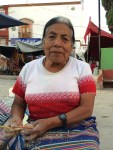
Men do the heavy lifting of erecting the tiendas, but it’s the women who run the tianguis.  When I came upon two women smashing white rocks into small pieces, and bagging them for sale, I had to ask a question.  The older woman in a straw hat told me they were breaking up marl for cooking with the corn for tamales. “This is a special rock,” she said.  The rock is largely calcium and it dissolves when boiled with the corn used in making the masa or dough for tortillas. I left them knowing more than I had before.

Later, I sopped at a large stand of chilis in burlap bags, and took a deep breath to savor the scent. The woman asked what I wished to buy.   Nothing, I said, and added that I stopped to admire her wares and inhale the scent of chilis.  This led to questions and answers about the kinds of chilis and the dishes in which they’re the key ingredient.  As I turned to leave, she gave me a handful of chilis as a gift.

More conversations followed with a woman who sold barks, leaves, and seeds as homeopathic cures for practially anything.  Each box of product labeled with a list of physical conditions the bark or leaf relieved, from headaches to anxiety to diabites.   Several vendors invited me to taste the fruits and other foods, many knew to me.   And always, informal conversation, questions asked and answered, a reality explored.

I ended by day talking with two Mixteco women, mother and daughter, sitting on a mat cleaning ‘aho’ or garlic and twinning the stems together, six garlic to a bunch.   Their question whether I wished to buy led to conversation and questions.  Before long, I was sitting on the plaza with them, and we were talking about our respective lives, families, and experiences.  The older woman, who gave her age as 80, had a soft voice and warm smile.  She lived nearby, her family raised garlic and other fruits.   Her daughter worked with her.  She told me, with some sadness, that her grandchildren didn’t want to learn or speak Mixteco, which is her first language.   They wanted only Spanish.  Without her saying so, it begged the question: “Who will carry on the culture?”  Who will take a tongue and culture of several thousand years into the twenty-first century?

That’s Tlaxiaco.  The sights, the sounds, and the smells of the ‘tiagnuis’ are lovely and fascinating on the surface.  But richer still is the connection of the tianguis to the place itself, and to the people of Tlaxiaco.  It’s in the organic connections of people to the place, and the place to the tianguis that the culture and languages – Mixteco and Spanish – live and evolve.   The Spanish of Tlaxiaco isn’t textbook Spanish, its a working language of slang and jargon and Mixteco words rooted in time and place and, hopefully, a future.


Shifting focus – “feeling” the language

OAXACA, Mexico

Can you “feel” the language when you speak Spanish? That is, do you have a sense of emotional confidence?  The kind of confidence to meet whatever circumstance you’re in?  Being self-aware of our emotional state is a useful aid in gaining fluency.  With confidence,  our focus shifts away from thinking about the words and grammar to focusing on the content of what we want to say.  This is something that seems to come with practice.

Everyone learns in their own way, but some fellow students have had common experiences on the road to fluency.   These are moments to treasure, like hitting a homer with the bases loaded.  Let me share several of my high points.

At the end of a food bank consultancy in Guadalajara, Luz, the chief volunteer and President’s wife, took me to a food distribution. After introducing me to the local leaders with generous praise, she turned and looked directly at me.

Suddenly, I realized she expected a response.  I had to say something more than “Gracias.” And I wasn’t prepared! Or so I thought. Swallowing momentary panic, I began, by thanking Luz for her kind words. And then I forgot about the words and concentrated on what I felt, what I wanted them to know. Miraculously, the words poured out without conscious effort, without hemming or hawing. I couldn’t quite believe what I’d just done: A spontaneous speech.  I felt both joy and pride.

Immersion experiences, formal and informal, can give us the base of experience to “feel” the language. By feeling, I mean an unspoken, intuitive trust that the necessary words will come to us when we need them. Think of Nik Wallenda, who walked the cable between Chicago sky-scrapers.  He succeeded because he wasn’t  preoccupied with falling.  Like him, we’re more likely to speak well if we aren’t preoccupied with making mistakes.

Test this:  Deliberately let yourself be drawn into a Spanish conversation that enters territory not covered by lessons, or involves somewhat complex topics. Asking someone about their profession is a good way to do this. Chances are you’ll enter a vocabulary thicket without a map. It’s a good way to practice trusting your intuition to serve up the words you need at the right time.  The words might be English cognates for Spanish ones, but you can modify many with ease.  And if you don’t know, you can always ask: “Como se dice,” or how does one say ….? One way or another, you can find a “work around” as you describe the idea, situation, or action for which you don’t have the exact word.  Even a work-around is a good exercise in conversation.

In the beginning, speaking Spanish in a complex conversation made me nervous.  It was like the first date with a girl I really liked.  I felt insecure, socially awkward, and wished I hadn’t asked the girl out.   The first date is always the hardest, but if you can survive the first date, and overcome the fear of rejection, or humiliation at your own hands, who knows? You may soon “go steady.”

Here are some signs to look for as you progress in building confidence on the road to fluency.

Dreaming.

Our minds rarely rest.  I remember waking from a dream in the middle of the night during my first immersion.  In stunned disbelief, I realized I had been dreaming in Spanish!  It happens to a lot of students. If it happens to you, trust it. It doesn’t mean you’re fluent, but it’s a sign you mind is absorbing the langauge at a an unconscious level.

Oblivious to the language you speak.

During my third week of immersion, I patiently answered a Mexican student’s interview questions for her English class project.  After the third question, the student’s companion stopped me and said: “Ingles, habla en ingles!  Tu hablas en espanol.”  That is, speak English, I was answering in Spanish and didn’t know it.  Again, I was flabbergasted that Spanish was becoming an unconscious “default” language.  What was happening to me?  Now I know.   And it’s happened several times since, in both languages. It’s another sign.

Catching mistakes before and after you make them.

Another sign of progress is catching yourself making or about to make a mistake. Relax. We all do it. Our brain moves faster than our tongue, our mind edits as we speak, and sometimes we change our mind, leaving our tongue still trying to conjugate verbs we’ve rejected on second thought.  We all do it in English, too.  Don’t criticize yourself for small mistakes. Perfectionism is a crippling disease. As a good yardstick, listen to how you speak English and note how often you make mistakes, or edits, or “uhs” and “ers.” Our conversations aren’t oral exams with a final grade. As long others understand us, we pass. Not trying at all is the only failure.

More energy at day’s end.

As Spanish sinks deeper into the subconscious, you may feel more energetic than when you started Spanish.  When we stop thinking about the language, and start feeling it, it takes less and less energy.  Being at ease means focusing on what you want to say, not how you want to say it. It’s like shooting a moving target; you follow the clay pigeon with your eyes and your body automatically brings the gun into position.

Talking with your hands.

You may also notice that your body language changes as you gain proficiency. The changes may be subtle or obvious. You may find yourself talking with your hands as well as your voice where you never did that before; or use more emphatic gestures. I notice that in Mexico I use my hands more than I do when talking in the U.S.

Try this:

Pay attention to your emotional state when engaged in a conversation that is going well, perhaps going easily. Notice how you feel, how much conscious energy are you investing in it.  Is it flowing without apparent effort?

How you feel when you speak – confident, nervous, fearful – will influence how well you speak. Self-awareness is one key in gaining fluency.  Like the tightrope walker, success lies not in looking down but in looking ahead.

Be sure to let me know if this works for you!

Chance encounters, improv Spanish

OAXACA,Mexico

Two college-age women approached me today near Oaxaca’s Santo Domingo.

“May we sing a song to you?” they asked. One was short, with braces, and dark hair; the other was taller, fairer, with curls.

“Why?” I asked, surprised at the request.

“We just want to make you happy,” the one with braces said.

“Make me happy for a donation?” I replied.

“Only if you want to,” the other said.

“Okay,” I said. “Please sing ‘Las Mananitas,” a traditional birthday and celebration song. They cleared their throats and sang reasonably well. After that, we talked for a moment and I learned they were art students. One studied drawing, the other painting. I gave them a few pesos, and the one with dark hair asked if I would like to hear “Cancion de Oaxaca.” I agreed, and she sang it in Zapoteco, the indigenous language. Then we wished each other “buena suerte,” or good luck.

How do you feel about chance encounters with strangers? Do you draw back, or lean in?

This chance encounter was utterly spontaneous and its outcome depended entirely on my response to their question. Although I’m long out of Spanish classes, this is still part of an on-going immersion process. Each encounter opens up an opportunity to use the language in a new way, in a different context, and with someone holding another point of view. I think of it as leaving the greenhouse of carefully cultivated classroom lessons and taking root in the soil of the street.

Only an hour earlier, I stopped in Oaxaca’s Zocalo, the normally placid and magnificent square between the cathedral and the government offices. But it wasn’t tranquil today. Tarps shaded much of it, here and there were pop-up tents where activists slept. Banners bore faces of adult protestors in detention, words denounced oppression by the state government. Other banners decried the disappearance of 43 students, along with a makeshift memorial of candles and a few wilting flowers.

Stopping at a table, I asked the three young women about the cause they were promoting. They laughed nervously as they talked. Their table had cans for donatons to the families of the students who disappeared. Each young woman was studying to be a teacher, one of Mexico’s best-paying opportunities for youths from poor villages, and they came from such places. The brutal loss of 43 students like themselves made them edgy and I heard tension in their voices. Although friendly, I felt their underlying anxiety from knowing it could happen to them.

“What are you doing in Oaxaca? one asked.

I told them I was teaching English in Tlacochuhuaya, another poor town. They smiled. I put 10 pesos in their donation box, and moved on.

Such moments come by chance, but they come if we look for them. Four years ago, on my way to Cuetzalan, I shared a bus seat with a campesino, a man of the country. In a jean jacket and cap, he might almost pass for a Minnesota farmer. Pedro and I began a conversation, and I asked him about the crops growing in the fields along the highway. “You know agriculture?” he asked. I said I grew up on a farm and knew agriculture.

Very quickly, our conversation and relationship changed. Within moments, we were deeply engaged in a conversation about the technicalities of agriculture in Mexico and Minnesota. The questions and answers flew quickly, some of them I didn’t understand at first, nor know how to answer. But we talked and talked for two hours until he got up to get out at the town of Libres.

As he prepared to leave, he said: “My family is having a fiesta in three weeks, I’d like you to come.”
His invitation caught me off guard. For a moment I thought I’d misunderstood him. “It’s an invitation?” I asked, to be sure.

“Si, una invitation.”

Joining his family would be interesting and I was filled with many emotions: pride, joy, and excitement that I could establish rapport to this extent. Unfortunately, it wasn’t to be. “I would love to meet your family, and you are very kind to ask me,” I said before I told him I couldn’t go because I had to return to the U.S. in a week. “I’m sorry.”

He looked down for a moment and then shrugged the way you do when you can’t change something. “Well, next time,” he said as he got off the bus.

What to make of these encounters? I’ve had lots of them in the last seven years. What do they add up to?

Experience. These encounters are what classroom lessons prepare us to. Classrooms are the beginning, not the end. Encounters are reality, this is language in context, language in use, language with muscles, and flaws, and surprising turns. It helps to think of these moments as “improv theater.” We just make it up as we go along. And in the moment, we are both the actor and the audience. This is where we build our confidence; confidence based on navigating social moments. It’s confidence honed by speaking with people without preparation in the topic. It’s confidence strengthened by straining to understand people whose articulation, or grammar, or syntax is out of whack, partial, imperfect. It’s real speech by real people leading real lives.
How do we do this?

First, let’s step away from our comfort zone in the hotel, the cafe, and the tourist shop where the conversation is predictable, limited, and the environment is familiar.

Second, let’s seek new territory. Look for an activity that piques our curiosity, or is new. Ask a someone an open-ended question to initiate a conversation. We aren’t looking for immediate information, like the location of the bathroom. Our question is intended to elicit an opinion, a point of view, something we and the other can share, if only for a moment. And we might ask the other person something about themselves. It’s that simple.

Third, let’s be present in the moment. Give the other person our full attention, listen closely, following up with another question if we can. Most of us are flattered by the attention of others. We are paying a compliment by being fully present to them. And they will reciprocate.

These are the steps I followed in each of the encounters above. In the case of Pedro, through an extended conversation, I made a friendship, however fleeting. In many other cases, I’ve encountered the same persons a year or two later and they have remembered our meeting. In one case a man recognized me before I noticed him.

This is immersion 2.0, the on-going learning, polishing, and perfecting of our Spanish.

Here’s your assignment. If you’re traveling, step away the hotel, cafe, or shop and look for a situation, a place, an activity where there’s an opportunity for an unexpected encounter. And if you’re not traveling, why not take a trip to the nearest Mexican grocery, mercado, or restaurant and use your language there. It’s improv and no one has ever died from doing this. And in the process, you might just receive the gift of friendship.

Next: el Dia de los Muertos