-

- Elaborate platform
-
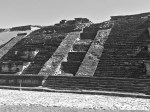
- A sancutary
-
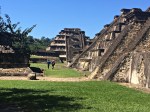
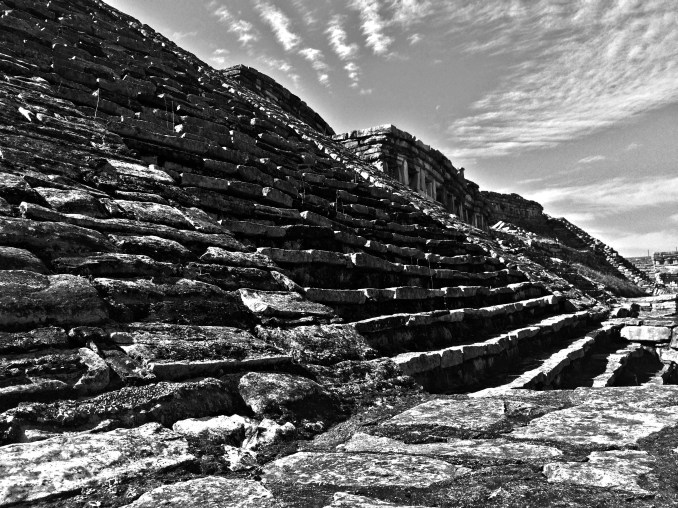
- Piramide de los Nichos
Have you ever wondered what catapults a people into greatness? How is it that a culture can survive for centuries long after the collapse of the kingdom that bred it? Wherever I go in Mexico, I see the remains of great city-state cultures that rose and dominated territories for centuries. In their time, they developed languages, forms of writing, literature, mathematics, mapped the heavens, created elaborate calendars, and developed food crops we can’t live without. Then the political orders collapsed, often abruptly, but their languages and cultures survived and continue to adapt to the present. What propelled their trajectories across the arc of history, like rocks launched from a catapult? What enables the cultures and languages bred in those civilizations to survive after the husk of empire falls away? Can such things happen to the United States?
I considered this question on President Obama’s last day in office; the day I arrived in Cuetzalan del Progreso, a Mexican town perched on a mountainside in Puebla’s Sierra Norte. Its residents speak Spanish and Nahuatl, and some speak Totonaco, two of Mexico’s 68 officially recognized languages that survived the collapse of their political cultures. The poems of Manuel Espinosa, a Totonaco poet who lives in Cuetzalan, bring into the 21st century the sensibility, spirituality, and identity of the Totonacos. Without its language, a culture dies.
My friend Lorena, once my Spanish conversation coach, lives in Cuetzalan and studies Nahuatl for her a master’s degree. We traveled together to El Tajin, a ancestral cultural site of the contemporary Totonac and Huastec people. The road to Papantla, a city on the Gulf Coast, was scarcely wider than the bus. It descended the altiplano’s escarpment by an organic route of broken asphalt and gravel, through jungle thickets, lime groves, and banana plantations. We rolled along a placid river rosy with the reflections of dawn .
El Tajin’s temples impress you with their massiveness but their origins remain somewhat obscure. Humans have occupied the place for nearly 7,000 years. During its apogee between 600 and 1200 A.D., Tajin dominated much of Veracruz state from until its destruction in 1230. Walking in the tropical heat, among the silent, carefully set stones, I wondered what force of will or visionary leadership made the Totonacs, the Huastecs, the Olmecs, the Zapotecs great in their time and place. And why did their kingdoms fail? Was their greatness the work of a charismatic leader or the blossom of a widely shared vision? What makes America, or any nation, great, I wondered?
-

- Ceramic bowl
-

- A carved basin
-
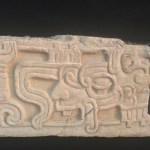
- A glyph at El Tajin
We explored El Tajin the day after the U.S. inaugurated a showman as President. He was an improbable candidate who rode into office demeaning Mexicans, promising to build a wall along the border, and break up NAFTA. What does it mean to ‘Make America Great Again?’ Does it mean anything? Or has a country already passed its apogee when the people want a leader who will remake their country as it was in a mythical golden age? That was my question for inauguration day 2017. The new President’s confusion of facts and lies pose a threat; he might destroy much without knowing it or, worse, without caring. Seeing Tajin’s great temples abandoned, I worry the barbarians are already at our gates.
Can any civilization survive its particular greatness? Is greatness sustainable? Do the concepts and values that bring a civilization into being contain a hidden seed of self-destruction? And where is that seed? Is it something small, unnoticed, or ignored until it sets in motion an irreversible cascade of problems ? Does any nation or people escape this? Archeologists and historians are left to wonder: Where did things go wrong? And why?
Greatness. What is it? And how does it come about? Wandering among the stones, seeing the design, the care, the precision in construction; I’m impressed. Surely, such greatness must be the flower from a unifying vision of the people, a communal vision, the whole being the fruit of many small things woven into daily life.
And what of American greatness? So many of our cultural norms rest on a belief in personal autonomy, an orderly and predictable society governed by laws and informed by science. We are optimists by nature; believers that tomorrow will inevitably be better than today, and upward progress is continuous. Unfortunately, the events of the last decade challenge this cultural idea. For many Americans, their todays are worse than their yesterdays and their tomorrows seem even bleaker. Those who felt forgotten or betrayed hitched their hopes, resentments, disappointments, and prejudices behind a campaign that promised to make America great once more.
Something similar happened in Minnesota on a smaller scale. Long a state with a progressive political and social culture, Minnesota burst into national consciousness in the mid-1970s with a Time Magazine cover story about ‘the good life’ in a state that ‘works.’ At the time, it was known for honest, collaborative politics, outstanding schools and colleges, numerous national corporations, engaged citizens, and an ethic of social responsibility. Unfortunately, Minnesotans have since taken their ‘goodness’ for granted, and the social compact has frayed to the point that the public prefers personal tax cuts to the cost of maintaining highways, schools, universities, and social services.
The decline of Minnesota’s ‘greatness’ and the collapse of Mexican civilizations reflect a loss of collective will and communal spirit in favor of a more individualistic, unequal, and antisocial attitude with widespread distrust of authority. Likewise, the social fabric of the United States is torn between narrow, competing visions of polity and the purpose of government. The culture has turned in on itself, consuming the good will that sustained diversity. Was this election a fundamental change in American civilization, or merely one episode among many? Sitting in the shade at El Tajin, I knew it was too early to know the answer. Nevertheless, it was not too early to ask this question. Will our culture and its greatness survive?
 Taking the long view—four millennia in the Museo Amparo. An afternoon in Puebla’s anthropological museum is a good place to thing amid its outstanding artifacts from Mesoamerican civilizations. I go often, and my four hours there (this time) passed through 4,000 years of human experience. The objects showed me other ways to view the cosmos, human fertility, divinities, writing, art, household utensils and political organizations. The variety of objects reflected amazing styles, some formal and realistic, others loose and abstract, still others as fresh as contemporary forms. Without writing, they used clay funereal figures with symbolic heads, noses, mouths and tongues to symbolize the virtues and accomplishments of the deceased—an obituary in ceramics. A video gallery of contemporary oral histories recounts cultural ideas and beliefs in Náhuatl, Mixe, Mixteca, Zapoteca, Chichimeca, and Maya—ancient languages still alive and necessary to meet human needs now as in the past.
 From museum galleries to artisans’ stalls in the mercado, you can see how creative energy flows from culture to culture, century to millennium. Sometimes the expression takes a new direction, at other times it doubles back on itself. Artifacts and products still throb with the human energy that pulses in our own veins and minds. You need only spend a day at the Amparo to see that primitive and advanced are meaningless ideas about cultures. Their abstract fallacy is the illusion there exists an objective standard by which to measure cultures. Human imagination seems always capable of rising to meet the needs and resources of a time and place. Comparing the artifacts and ruins of the past with the present doesn’t tell us we are more advanced as human beings. ‘Progress’ is a seductive but conceited notion; a false assumption that cultures rise upward through time toward some imaginary finish line. The ruins tell us another story.
 It makes me wonder if, in the rush of modern, urban life in the U.S., we take too little or no time to acknowledge the presence of those we don’t know. We all hunger for connection, for the affirmation of our being, but I fear we may have wrung it out of our culture with our utilitarian focus on work, and our isolation within the bubbles of shared opinions, social class, and race. Still, I believe there is a simple, human path out of our present divisions—to simply and sincerely acknowledge the presence of the ‘other,’ the person you don’t know, the person who thinks differently, or the foreigner you may otherwise fear. A simple acknowledgment of our shared existence as humans makes other connections possible and narrows the distances between us. It isn’t difficult.

 communal effort. Sunset was nearly on us when we slipped through the cattle gate and hiked up the mountainside through the grass. The large tank sat on a concrete pad fed by tubes from springs tapped farther up the slope. A tube at the bottom of the cistern channeled water to a dozen smaller tubes that ran downhill to the houses in the hamlet below. Water is scarce in parts of Mexico, and even scarcer in the midst of a drought. The construction, operation, and maintenance of the simple cistern is a communal project, a shared vision. This small project, multiplied by millions of people, is what makes a great civilization. This is greatness working in an indigenous municipality. We can all learn from the past, if we will.
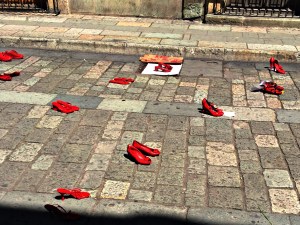
 Walking along the Alcala, Oaxaca’s street of high-end shops and tony restaurants, I’m surprised to see dozens of shoes, each the color of blood, set out in pairs on the gray cobbles. What is this, I wondered as I joined the cluster of Mexicans around the informational banner.
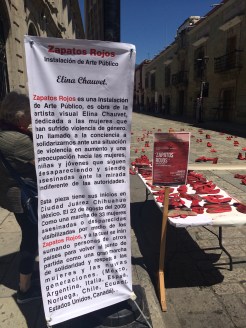 Tourists passed the exhibition, most of them glanced at the crimson shoes, but few stopped to read the banner before they entered the shops and restaurants. Nevertheless, the silent, empty red shoes screamed to those of us who read the banner.
 The women’s emotions drove their stories of pain and loss. Now and then, each paused to wipe her eyes or regain her voice. Their words flashed like sharp knives, paring away the hypocrisy of police and public officials who told them not to worry, their daughters were probably off with their boyfriends. Or worse, officials told them the girl was probably a prostitute or drug addict—as if that justified their deaths. One by one, the mothers demanded an end to ‘la cultura machista’ that protects the men—including police—who treat women as less than human.
 Nor can women rely on the authorities to protect them from drug cartels that coerce women into transporting drugs and filling logistical roles. According to a former director of the National Women’s Institute (Mexico City), cartels force women into prostitution because the sex trade is the third most profitable market after drugs and small arms.
 It is often said that travel and a second language broaden one’s perspective. And this is true. Once we gain another language, and our cultural horizons widen, we are vulnerable to the moral questions once invisible to us. The violence against women, like the sexual abuse of children, becomes culturally pervasive when society turns a blind eye and says it’s a private matter. I can no longer say I didn’t know, and silence in the face of evil isn’t a moral option.







 Adventures in Midlife Spanish